the internet is endlessly informative and entertaining. and sometimes, you find stuff that might be corny, but it strikes a chord with you.
so it is with this snippet and me:
"never forget the three kinds of people in your life. The three kinds are: 1. Those who helped you in difficult time. 2. Those who left you in difficult times. and 3. Those who put you in difficult times."
So, i'm guessing that while you are remembering these folk, you should be reciprocally good to those who helped you in difficult times. easy enough. but what exactly should you do with the other 2, besides be an elephant and not forget them? i'm wondering what else you do.
and while i'm wondering, i'm thinking: interestingly enough, i have more of a hatred for those (or the one) who left me in a difficult time than i have for anyone who put me in a difficult time. perhaps, because any difficult time that someone put me in, i partially put myself in. i consider my ownself as partly to blame for the difficult times.
but in the end, whether they or you or something random is the cause of the of your difficult time, people in your life (whether they are 1's or 3's) then make a choice for themselves to be a 1 or a 2.
so as i said, i have great disdain and hatred for "those" who left me in difficult times. the 2. because, that is the person who either took a look and disregarded that i was having a difficult time, or was so wrapped up in himself, that he didn't even regard taht i was having a difficult time. what i'm saying is that either way, he made a choice that i wasn't worth it. and he took off.
how do i not hate that?
so i'm thinking- despite what the little quote says, quite honestly it would be my most fervent hope to not be an elephant and to be able to forget that person right out of my mind forever.
i'd like to get rid of his memory altogether, forget that he ever existed in my life. i really would like "an eternal sunshine of the spotless mind."
and as it turns out, i guess that scientists are saying now that you can actually do this. in fact, there are two ways. here, read this:
"What they found is that if you want to get something unpleasant out of your memory, there are two ways to go about it. You can directly surpress the memory every time it emerges, or you can use substitution to overwrite it with something else.
Write the researchers:
One mechanism, direct suppression, disengages episodic retrieval through the systemic inhibition of hippocampal processing that originates from right dorsolateral prefrontal cortex (PFC). The opposite mechanism, thought substitution, instead engages retrieval processes to occupy the limited focus of awareness with a substitute memory. It is mediated by interactions between left caudal and midventrolateral PFC that support the selective retrieval of substitutes in the context of prepotent, unwanted memories."
and the article i read goes on to say that people can be better at one method or the other. something tells me i'd be better at the substitution one. because- suppression hasn't worked so well for me. i've been trying it for years upon years. and somehow, it's like the elephant in the room thing for me. the more i try to forget, the less i can.
and keeping with our elephant theme, did you know that elephantitis is a disease that is characterized by the thickening of the skin and the underlying organs? underlying organs, such as your heart. so yeah. i can't just can't seem to thicken my skin enough for the first option of suppression.
so i need a substitution. a kind of replacement.
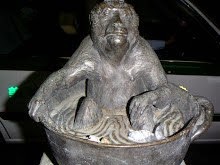
so the question is i guess, what do i use for a replacement? it has to be something really big. elephant big.
Thursday, June 13, 2013


Sunday, June 9, 2013
down the road and down the road
perhaps my daughter's favorite book when she was little, was margaret wise brown's "home for a bunny." if i had a nickel for every time i read the lines "down the road and down the road..." to her, i likely could have paid for her college education with it.
"down the road and down the road and down the road he went."
here's the beginning of it-
in the spring a bunny came down the road.
he was going to find a home of his own.
a home for a bunny, a home of his own.
under a rock
under a stone,
under a log,
or under the ground.
where would a bunny find a home?
see i told you that i read this a lot. that was from memory. (-:
actually, i quite loved this little book too.
anyway, it's funny. i was in my hometown overnight last night, and when i was driving back here to my new home here, i was thinking about my son and my daughter, and then my mind was wandering and i found myself reciting this book to myself. outloud in my car.
i suppose other drivers passing me thought i was singing along to the radio or something. but they had no idea, that i am even goofier than that.
down the road and down the road and down the road, i went.
Monday, June 3, 2013
thoughts about mental health.
so even while i'm out of the business, i do like to keep up with things. and as you might know, they have made some changes is the Diagnostic and Statistical Manual of Mental Disorders. the DSM-v, if you will.
and most people are stirring about this for the changes made to conditions concerning autism. and a few are spinning around on the changes to intellectual disorders, formerly known as mental retardation.
but the changes i think are truly interesting are these 3.
1. Disruptive Mood Dysregulation Disorder
Definition: Children up to age 18 who exhibit persistent irritability and frequent episodes of extreme temper tantrums.
What's Changed? This disorder is new with the DSM-5 and is meant to address concerns about overdiagnosis and overtreatment of bipolar disorder in children.
2. Oppositional Defiant Disorder
Definition: An ongoing pattern of anger-guided disobedience, hostility, and defiant behavior toward authority.
What's Changed? The criteria explain how frequently the behaviors must occur to differentiate them from normal development in children; symptoms have been grouped into angry/irritable mood, argumentative/defiant behavior, and vindictiveness.
3. Social Communication Disorder
Definition: A persistent difficulty in social uses of verbal and nonverbal communication, such as greeting or exchanging information; following rules for conversation or storytelling, such as taking turns in conversation; and understanding what is not explicitly stated and nonliteral or ambiguous meanings of language.
What's Changed? The disorder is new to the DSM-5. It is meant to identify people who have some of the communication deficits associated with autism, but who do not have repetitive or restricted behavior patterns.
The first two bring to mind a joke that i once heard Ellen DeGeneris say: "Back in my day, we didn't have all these fancy names for disorders. people were just crazy. that's all." Actually, all 3 of these put me in mind of her joke, I mean, the way the 3rd one is described could be a whole heck of a lot of people. people who are uncomfortable at cocktail parties? people who were never taught manners? people who don't know how to "smooze" the boss.
but, really i guess the first two of these disturb me more. because while i fully believe that the bipolar disorder
has been handed out like candy, i still really kind of think that we really do just have a whole lot of parents who either don't know how to-or simply don't function, as parents. and that a lot of these kids have been created by those parents. (and i would be quick to add that these non-functional parents include both the abusive AND those who because they can't stand their child to ever be hurt or can't stand for them not to shine brighter than other kids, and/or get anything wrong, make excuses for them, and don't discipline.)
but anyway, the cure to me wouldn't be to diagnose and treat the children, the cure would be to provide consistent structure and rules and consequences for them to live by. and having a court system that actually works with the schools.
As to the ODD, I guess it's good they are now giving guidelines as to when a kid truly has this or when he or she is just a normal kid going through an assy-phase. Again, i think the key to working and treating these kids is to give them clear, kind, and consistant rules to live by with consequences for not behaving nicely.
do i think there are truly mentally ill children? of course i do. i've seen them. i've worked with them. but i'm not talking about them. i'm talking about kids that get diagnosed in some way soley because of their behavior.
Interestingly enough, I wrote this first part earlier today, then I had to go into work. On my way home this evening, I heard an npr backstory that was prompted by the Dsm being changed and they talked about some of the earlier changes to the dsm manuals and some bizarre-ish things that were once labled as mental disorders. sleepwalking was one of the examples they gave. once that was defined as a mental illness. so, it appears that i'm not the only one who questions some of this stuff. they also talked about how unwise it is whenever we seek to diagnose someone as having something on the basis of it's definition. for example, diagnosing someone as depressed because they are reported as being depressed. huh? really? maybe they are really depressed. but perhaps there is a real and actual legit reason for them being depressed. such as a death. or a loss.
i don't know. i guess what i would be in favor of is less diagnosis and labeling and more just helping people if they have problems.
something else i listened to on my ride home tonight was the "moth" storytelling program that came on before the "backstory" program. one of the storytellers was describing an experience he'd had in senegal, where villager who this guy was living with had performed a rather bizarre ritual to chase out some demons or something that they believed this guy had. and he spoke about how as wierd as the whole thing was, after it was over, he truly felt uplifted and better. and at the end of his story, he told how sometime later he visited another village in Africa, but in a completely different part, and he'd told someone there of his experience. and the person he related the story to told him that in their village they had a fairly similar ritual to the one described. then the person went on to say that at one point they had had to ask some mental health workers from the u.s. to leave. and when questioned "why," he replied that rather than using community efforts and using uplifting or cathartic experiences in the open air and sunshine to bring people out of whatever condition they were afflicted with, those u.s. mental health workers kept wanting to drag people with problems into dark rooms and have them tell them all the bad things that had happened to them. this did not seem to make anyone better. only worse. so they were asked to leave. the country.
this made me laugh. because hmm. how little sense does most of our mental health system make sometimes? i think back to a time when i was sorely depressed. horribly depressed. it hurt to move depressed. i wanted to die depressed. and while yes, it was really great to be able to talk about my problems to someone, so that i didn't have to bore my friends, it did little more than make my wheels spin. i kept telling the clinicians and counselors if they could just tell me how to work out the situation that was making me so sad, that this would make me feel better. but they instead seemed to think that i needed to fix myself from the inside. instead they wanted me to talk about it and through talking about it, make revelations of some kind. arrggg.
cuz the truth was, i really wasn't needing fixed in the sense that there was something wrong with me, what i was needing help with was to feel better. and while talking about it was maybe good for me, making revelations of some kind was useless. i was already self aware. too self aware.
and maybe it was because they really had no answers to the situation that caused the pain, but don't you think the honest and more logical thing to do then was to tell me that they could not help me fix that situation? and that there would be no fix, but only that they would hang with me until i began to feel better? and you know what i think would have really helped me as i grieved? things like being read to. music therapy, where i didn't have to talk. taking walks with another person. painting pictures. playing board games. making things out of playdough. basket weaving, maybe. something, anything that got me through another minute or two. and where i wasn't alone, but nothing in particular was expected of me.
don't you think there should be places like that? recess places that you can just go to when you are feeling sad or depressed or angry or anxious. where nothing in particular is asked of you, besides you not hurting anyone else, but you can go in listen to a story or bang on a piano or a drum. or fingerpaint. or throw a pot. or dig in some dirt and water some plants. some place where you're not alone, because other people are there playing too, but it's ok (and expected) that you come alone. and stay as long as you feel like it. and do as little or as much as you want to. oh and a massage or two (-:
hmm. i'd have paid a lot of money for a place like that to go to. all that money that i threw away on mental health services would have been better spent at such a place as that.
Saturday, June 1, 2013
the handicapped.
so, i have this stance on crudeness in life. i don't like it. i don't like people behaving crudely. in real life or on the internet. or on tv. i'm repelled by it. i'm repulsed by it. i hate the public discussion of bodily functions. i hate tv commericials about bladder control and feminine itch and tampons. i hate crass jokes based solely on crudeness and the desire to "show off" how "free" you are. i don't even really like it when people swear. i really don't.
and imagine my surprise and disconcertion when one of my best friends posted a fb thing about how i drink too much and swear too much, etc., but that's why she likes me. i really flinched. not because of the trueness of the drinking part. i have been known to have a glass of wine too many, i freely admit to that. but because of the swearing. because i swear to you, that i very rarely actually swear. and not because i'm a prude, i'm not shocked or really offended by bad language, it's just that i just really don't like how it sounds. and i don't want it coming out of me.
because it just seems crude to me, i most usually will choose not to swear. which is not to say that i never do. i just reserve it for emphasis of meaning sometimes, is all.
and all of this might seem quite inconsistant with my extreme love of the tv cartoon, South Park. i love that show, even while it can be the crudest of all shows at times. i love it. why? because it's funny. and it tackles political and social issues in both the subtlest and most outrageous ways. and no subject is too sacred to be examined in absurdist manner. i think that's what i like about it- it's not crude as much as it uses absurdity and humor to make the points it makes.
enter my LOVE for the character timmy. you'd think that because of my life's work with children with disabilities, that i would hate hate hate the character of little timmy. but quite honestly, i think timmy is the best character on the show because of how he's portrayed. and because of the absurdities that his character brings to the table surrounding people's perceptions of people with disabilities. and most of all, i just love how the South Park kids seem to be able to do what adults seem to find impossible to do, they just like timmy for who he is. they don't see him as an "in spite of" human being. you know "in spite of?" as in "in spite of his amputation, he climbed a mountain" or "in spite of her blind and deafness, she became a public speaker, cured cancer, and learned 5 languages." or "in spite of his cerebral palsy, he's just so adorable."
the South Park kids just like timmy, because he's there to like. not because he's accomplished anything great or because he's cute. i love that.
and i like that they don't give him any more consideration than the next character. the wheelchair or the seeming mental retardation, don't give him special priveleges or rights in their eyes. he is who he is and he gets what he gets, the same as the rest of them. i even love that for the most part, the teachers just sort of ignore his presence. he's nothing special to them, because he's not special, he's just another kid.
when i first started teaching, i taught in an institution that is now illegal. what we called a separate facility. it was for students, who had disabilities only. it was considered "best" for all at the time. and there are still people in this world that would consider it "best." i never did. but that's where i got a job at first. because that's what there was. and i was real high on the movement to end that exclusionary practice and institution, which did not always win me friends, back in the day. (but that's an aside.)
anyway, at every holiday, a local women's church group would come in and throw parties for our students. they'd bring seasonally colored cupcakes and red (the kinds that stains) hi-c and party napkins and cups, and little trinket party-favor gifts and they'd spend an hour and a half, setting out all their offerings in our little cafeteria. and at an appointed time, someone would give the word and we'd all go down to there, where we'd sit at the lunch tables in our little class configurations. and while the teachers and aides would physically stuff cupcake bits in the mouths of those unable to feed themselves, they'd all stand there and stare at the kids while they ate. occasionally there would be a shy smile or a little tear in the eye or a whispering to the others of their charity, in too loud of voices, about how adorable the little downs kids were (those people are always down with the downs kids, until they grow up and become downs adults) or how we (the staff) were saints.
and i would think to myself, "yeah, we're xxxxing saints, alright, for putting up with YOU people." i seriously hated the church ladies, enough to swear at them in my head. i never once saw any one of them get their hands all messy from the chemical mixture of red hi-c and blue icing and a kid's saliva. i never once heard one of them say that any of the non-downs kids were cute.
i never once saw or heard anyone of them sit down and have an actual interaction with a kid, beyond the occasional pat on the head of a particular kid, who they were positive didn't have lice.
it was like we were a zoo. and in fact, that's what i called those days- "petting-zoo days" and the worst part was the end, when we'd have to roll and parade the kids past the line of them and have each child in their own way, individually "thank" the kind women for the experience of being a zoo animal. i hated hated hated it. and the only way i could deal with it was to think about how it was wise to teach these children the social convention and necessity of saying "thank you" to people, even if you hated them, because they had the money who would fund your field trips or you adaptive device. i thought, "best to teach them how to sing for your cupcake, because that will generalize someday into grant-writing, that will get you the good stuff."
Subscribe to:
Posts (Atom)